
Radon Testing
2024-25 Testing
-
PBS Engineering and Environmental Inc. (PBS) performed short-term radon testing from November 12 through 14, 2024 the Library and Room 22 within Davis Elementary School in Portland, Oregon. This was performed following initial short-term radon testing and subsequent renovations of the spaces.

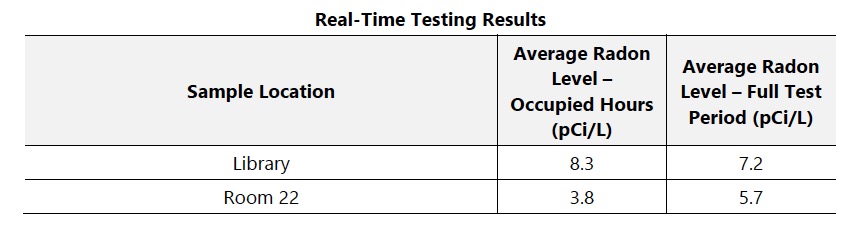
PBS Engineering and Environmental Inc. (PBS) performed real-time radon testing from November 22 through 24, 2024 in the Library and Room 22 within Davis Elementary School in Portland, Oregon. This was performed following initial short-term radon testing using passive radon monitors which indicated average concentrations of radon between four and eight picocuries per liter (pCi/L) of air.
- If the result is less than 2.0 pCi/L, school districts are required to test again every 10 years, per Oregon Revised Statute 332.166-167.
- If the result is between 2.0 pCi/L and 4.0 pCi/L, consider fixing (i.e., lowering) the radon in that room.
- If the result is from 4.0 pCi/L to 8.0 pCi/L, perform a follow-up measurement of that room using a long-term test. This test should be conducted over as much of a nine-month school year as possible, when the room is likely to be occupied. If that result is equal to or greater than 4.0 pCi/L, the radon in the room should be fixed (i.e., lowered).
- If the initial short-term test result is equal to or greater than 8.0 pCi/L, conduct a second short-term test and average its result with the initial short-term test result. If the average of the two is equal to or greater than 4.0 pCi/L, radon in the room should be fixed (i.e., lowered).
CONCLUSIONS AND RECOMMENDATIONS
Library
- Average concentrations of radon exceed the action level during occupied hours. Therefore, steps should be taken to reduce occupied-hour radon concentrations.
- Fresh air ventilation should be increased during occupied hours and the room should be retested.
Room 22
- Average concentrations of radon were slightly below the action level during occupied hours.
- As radon concentrations were above action levels for much of the test period, The District should consider increasing fresh air ventilation during occupied hours.
-
PBS Engineering and Environmental Inc. (PBS) performed short-term radon testing from November 12 through 14, 2024 in room 10 within Margaret Scott Elementary School in Portland, Oregon. This was performed following initial short-term radon testing and subsequent remedial actions.

- If the result is less than 2.0 pCi/L, school districts are required to test again every 10 years, per Oregon Revised Statute 332.166-167.
- If the result is between 2.0 pCi/L and 4.0 pCi/L, consider fixing (i.e., lowering) the radon in that room.
- If the result is from 4.0 pCi/L to 8.0 pCi/L, perform a follow-up measurement of that room using a long-term test. This test should be conducted over as much of a nine-month school year as possible, when the room is likely to be occupied. If that result is equal to or greater than 4.0 pCi/L, the radon in the room should be fixed (i.e., lowered).
- If the initial short-term test result is equal to or greater than 8.0 pCi/L, conduct a second short-term test and average its result with the initial short-term test result. If the average of the two is equal to or greater than 4.0 pCi/L, radon in the room should be fixed (i.e., lowered).
-
PBS Engineering and Environmental Inc. (PBS) performed short-term radon testing from November 12 through 14, 2024 in room 606 of HB Lee Middle School in Portland, Oregon. This was performed following initial short-term radon testing and subsequent renovations of the space.

- If the result is less than 2.0 pCi/L, school districts are required to test again every 10 years, per Oregon Revised Statute 332.166-167.
- If the result is between 2.0 pCi/L and 4.0 pCi/L, consider fixing (i.e., lowering) the radon in that room.
- If the result is from 4.0 pCi/L to 8.0 pCi/L, perform a follow-up measurement of that room using a long-term test. This test should be conducted over as much of a nine-month school year as possible, when the room is likely to be occupied. If that result is equal to or greater than 4.0 pCi/L, the radon in the room should be fixed (i.e., lowered).
- If the initial short-term test result is equal to or greater than 8.0 pCi/L, conduct a second short-term test and average its result with the initial short-term test result. If the average of the two is equal to or greater than 4.0 pCi/L, radon in the room should be fixed (i.e., lowered).
-
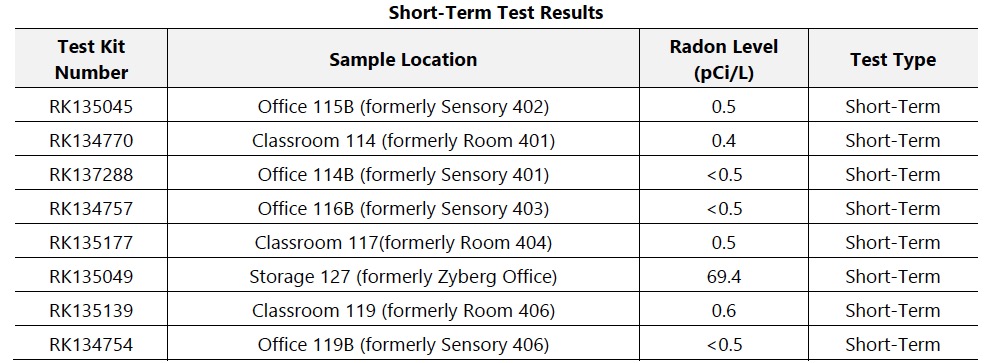
PBS Engineering and Environmental Inc. (PBS) performed short-term radon testing from November 12 through 14, 2024 in five spaces within HOLLA School in Portland, Oregon. This was performed following initial short-term radon testing and subsequent renovations of the spaces.
- If the result is less than 2.0 pCi/L, school districts are required to test again every 10 years, per Oregon Revised Statute 332.166-167.
- If the result is between 2.0 pCi/L and 4.0 pCi/L, consider fixing (i.e., lowering) the radon in that room.
- If the result is from 4.0 pCi/L to 8.0 pCi/L, perform a follow-up measurement of that room using a long-term test. This test should be conducted over as much of a nine-month school year as possible, when the room is likely to be occupied. If that result is equal to or greater than 4.0 pCi/L, the radon in the room should be fixed (i.e., lowered).
- If the initial short-term test result is equal to or greater than 8.0 pCi/L, conduct a second short-term test and average its result with the initial short-term test result. If the average of the two is equal to or greater than 4.0 pCi/L, radon in the room should be fixed (i.e., lowered).
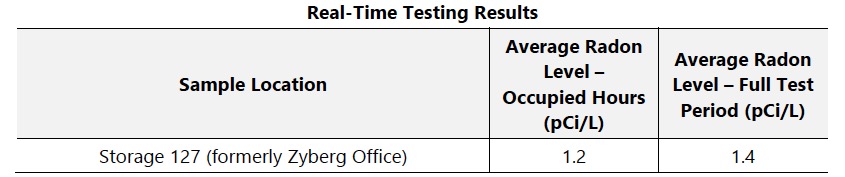
PBS Engineering and Environmental Inc. (PBS) performed real-time radon testing from November 22 through 24, 2024 in Storage 127 (formerly Zyberg Office) within HOLLA School in Portland, Oregon. This was performed following initial short-term radon testing using passive radon monitors which indicated average concentrations of radon exceeding eight picocuries per liter (pCi/L) of air.
CONCLUSIONS AND RECOMMENDATIONS
- Based on the above results, it appears likely that the initial elevated result was due to the inappropriate placement of the test device. Actual radon concentrations remained low throughout this follow-up test period.
- This room may be returned to service.
2018-19 Radon Testing
-
Re: Radon Testing Update – Initial Testing Completed (Alder Elementary)
The health, safety, and well-being of our students and staff are top priorities at Reynolds School District. This letter is to update you on the initial radon testing performed in Alder Elementary. Under a 2015 Oregon law (ORS 332.166-167), Oregon schools must be tested for elevated radon on or before January 1, 2021.
To meet the required timeframe early, Reynolds School District began testing for elevated radon levels in November 2018; PBS Engineering and Environmental Inc. was contracted to help conduct monitoring and mitigation procedures.
Radon testing devices were placed in 56 areas of the building(s) that are frequently occupied. Of those rooms, 25 areas tested above the EPA recommended action level of 4.0 picocuries per liter (pCi/L). Reynolds School District’s response to elevated radon results has been prompt and comprehensive. The rooms that tested at or above 4.0 pCi/L are subject to longer confirmation testing and temporary mitigation systems.
Reynold’s School District is working closely with PBS Engineering and Environmental, Inc. to execute a plan to mitigate elevated radon levels and Alder Elementary. This plan includes:
• Checking classrooms and other areas with elevated levels to ensure air flow vents are not blocked and there are no cracks in flooring.
• Checking and servicing HVAC systems to ensure they are operating property.
• Retesting rooms with levels at 8.0 pCi/L or higher over a three-day period beginning February 11, 2019 pending any weather-related delays.
• Retesting of rooms with levels between 4.0 and 8.0 pCi/L with long-term testing beginning in February and ending in May 2019.
Radon is a naturally occurring radioactive gas that you cannot see, smell or taste. It is the number-one cause of lung cancer among non-smokers, according to the Environmental Protection Agency (EPA). Elevated radon can be found across the country and in all different types of buildings, including homes and schools.
Breathing air with radon gas does not cause any immediate health effects, and not everyone exposed to elevated levels will develop lung cancer. Lung cancer usually occurs many years after exposure. Individuals who are exposed to high radon levels over long periods of time are the most at risk. Because students and staff of school buildings spend much of their time at home, the home may be their most significant source of radon exposure. The EPA recommends that all homes and schools be tested for radon.
Please see Alder Elementary Frequently Asked Questions (FAQs) about radon, and visit Oregon Health Authority’s (OHA) radon website to learn more.
Information on how to test your home is also found on OHA’s webpage. You can contact OHA’s Radon Awareness Program at 971-673-0440 or radon.program@state.or.us.
If you have any questions or concerns about radon testing at Alder Elementary, please feel free to contact Reynolds School District Facilities Maintenance at (503) 661-7200, ext. 3440.
FAQs:
Q: What is radon?
A: Radon is a naturally occurring radioactive gas that you can’t see, smell or taste. Because radon is a gas, it can seep up through the soil and enter buildings, like homes, schools and workplaces. There are high levels of naturally occurring radon in several locations throughout Oregon.
Q: How is radon measured?
A: Radon in the air is measured in units of picocuries per liter (pCi/L). The Environmental Protection Agency (EPA) strongly recommends you take steps to reduce radon if levels are higher than the action level of 4.0 pCi/L. Radon risk reduction in buildings is also known as mitigation.
Q: What are the health effects?
A: Radon is the second leading cause of lung cancer in the U.S. Breathing radon does not cause any short-term human health symptoms such as shortness of breath, coughing, headaches, or fever. The risk of developing lung cancer increases when an individual breathes air with high levels of radon over a long period of time. The risk also depends on many other factors such as genetic disposition, family history, smoking, presence of other indoor air quality issues (at home, school or work), radon levels, the type and condition of building and ventilation systems, seasonal and weather variations, etc.While radon is proven to cause cancer, not everyone exposed to elevated radon levels will develop lung cancer. For those who do, the onset of lung cancer usually occurs years after exposure.
If you live in a home with high radon levels, smoking raises your risk of lung cancer by 10 times. Smoking is the leading cause of lung cancer in the U.S. If you are ready to quit smoking and would like help, contact the Oregon Tobacco Quit Line by calling 1-800-QUIT-NOW, or visit their website at www.quitnow.net/oregon.
Q: What prompted Reynolds School District to test for radon in Alder Elementary?
A: Reynolds School District began testing for radon in November 2018 to comply with the state legislation, ORS 332.166-167, mandates radon testing in every public school by January 2021.
Q: What is Reynolds School District doing to make sure classrooms are safe and that all buildings are tested and mitigated if needed?
A: Reynolds School District is working closely with PBS Engineering and Environmental, Inc. to execute a plan to mitigate radon levels in Alder Elementary. This plan includes:• Checking classrooms and other areas with elevated levels to ensure air flow vents are not blocked and there are no cracks in flooring.
• Checking and servicing HVAC systems to ensure they are operating property.
• Retesting rooms with levels at 8.0 pCi/L or higher over a three-day period beginning February 11, 2019 pending any weather-related delays.
• Retesting of rooms with levels between 4.0 and 8.0 pCi/L with long-term testing beginning in February and ending in May 2019.
Q: Should students, staff and visitors be allowed in school buildings with rooms that have high levels of radon?
A: Since radon occurs naturally, a person can never completely get away from it. According to the EPA, radon averages 1.3 pCi/L inside and 0.4 pCi/L outside homes and buildings across the country.The overall goal of radon reduction is risk reduction. So the lower the levels of radon that an individual is exposed to, the better. However, radon levels can be influenced by building design, room size, etc.
Large buildings, like schools, have many rooms and the radon levels in each room may be different from each other. The focus of radon testing is not on the school building as a whole. Instead, the goal is to understand radon levels in individual, frequently-used rooms in the building where people may spend long periods of time. The EPA recommends school officials consider relocating individuals in rooms that have radon levels near 100 pCi/L. However, it is likely that school officials will evacuate rooms at a much lower level.
Because students and other occupants of school buildings spend much of their time at home, the home may be a significant source of radon exposure. The EPA recommends that all homes AND schools be tested for radon.
Q: Do children have a greater risk of cancer from radon exposure?
A: Children are usually more sensitive to environmental pollutants. However, no current data concludes that children are more at risk than adults from radon exposure.
Q: Can my child be tested for radon?
A: There is no medical test for radon. The only way to find out an individual’s radon exposure is to test the inside of buildings like homes and schools, where the majority of time is spent.Children spend more than twice as much time at home as they do in school. While school districts are testing the radon levels within their school buildings, parents should also be testing their homes for radon to reduce that potential exposure pathway.
Q: While my school is performing radon testing and mitigation, what can I do to reduce my or my child’s risk?
A: There are many ways to reduce your radon risk:• Test your home for radon. You can find do-it-yourself (DIY) test kits similar to those being used for testing in schools at a local hardware store. Or you can order one online from the American Lung Association. Information on where to find a test kit is below.
• If high levels are found at school or within your home, encourage local residents to test their homes.
• If you are a smoker, stop smoking. Or at least cease smoking inside of the home. Call 1-800QUIT-NOW for help.
Q: Where can I find the school’s radon test results?
A: You can find testing results on the district website.
Q: Where can I find a radon test kit?
A: DIY radon test kits can be found at most local hardware stores for around $10 to $40 plus shipping and analysis fees. The following resources also offer DIY radon test kits:• American Lung Association o https://www.lung.org/local-content/_content-items/our-initiatives/current-initiatives/mpor-radon-awareness.html
• National Radon Program Services o http://sosradon.org/test-kits
• Oregon Radon Awareness Program offers FREE radon test kits to those living in areas where no risk level is assigned on the Radon Risk by Zip Code Map. Please email radon.program@state.or.us to find out if you are eligible. o https://www.oregon.gov/oha/PH/HEALTHYENVIRONMENTS/HEALTHYNEIGHBORHOODS/RADONGAS/Pages/index.aspx
• The National Radon Proficiency Program has a webpage listing of all approved consumer devices (http://aarst-nrpp.com/wp/consumer-devices). Going directly to the labs can be much less expensive.
Q: Are the test kits safe?
A: Yes. However, kits should be kept away from very young children (toddlers and infants) so they don’t eat or chew on them.
Q: How do I find out radon levels in my rental home?
A: You can ask you landlord if the home has already been tested. If so, request a copy of the test results. If not, you can ask the owner to test or you can test yourself using a DIY test kit (see above Q: Where can I find a radon test kit?). At this time, Oregon does not have any specific radon standards or regulations for rental homes.
Q: Where can I learn more about radon?
A: Resources:• Oregon Health Authority: www.healthoregon.org/radon
• Environmental Protection Agency (EPA): http://www.epa.gov/radon
• EPA – Radon in Schools: http://www.epa.gov/radon-schools
• Centers for Disease Control and Prevention: http://www.cdc.gov/radon/
• National Radon Program Services: http://www.sosradon.org; 1-800-SOS-RADON
-
-
-
-
Re: Radon Testing Update – Initial Testing Completed (Alder Elementary)
The health, safety, and well-being of our students and staff are top priorities at Reynolds School District. This letter is to update you on the initial radon testing performed in Alder Elementary. Under a 2015 Oregon law (ORS 332.166-167), Oregon schools must be tested for elevated radon on or before January 1, 2021.
To meet the required timeframe early, Reynolds School District began testing for elevated radon levels in November 2018; PBS Engineering and Environmental Inc. was contracted to help conduct monitoring and mitigation procedures.
Radon testing devices were placed in 49 areas of the building(s) that are frequently occupied. Of those rooms, 10 areas tested above the EPA recommended action level of 4.0 picocuries per liter (pCi/L). Reynolds School District’s response to elevated radon results has been prompt and comprehensive. The rooms that tested at or above 4.0 pCi/L are subject to longer confirmation testing and temporary mitigation systems.
Reynold’s School District is working closely with PBS Engineering and Environmental, Inc. to execute a plan to mitigate elevated radon levels and Alder Elementary. This plan includes:
• Checking classrooms and other areas with elevated levels to ensure air flow vents are not blocked and there are no cracks in flooring.
• Checking and servicing HVAC systems to ensure they are operating property.
• Retesting rooms with levels at 8.0 pCi/L or higher over a three-day period beginning February 11, 2019 pending any weather-related delays.
• Retesting of rooms with levels between 4.0 and 8.0 pCi/L with long-term testing beginning in February and ending in May 2019.
Radon is a naturally occurring radioactive gas that you cannot see, smell or taste. It is the number-one cause of lung cancer among non-smokers, according to the Environmental Protection Agency (EPA). Elevated radon can be found across the country and in all different types of buildings, including homes and schools.
Breathing air with radon gas does not cause any immediate health effects, and not everyone exposed to elevated levels will develop lung cancer. Lung cancer usually occurs many years after exposure. Individuals who are exposed to high radon levels over long periods of time are the most at risk. Because students and staff of school buildings spend much of their time at home, the home may be their most significant source of radon exposure. The EPA recommends that all homes and schools be tested for radon.
Please see Glenfair Elementary Frequently Asked Questions (FAQs) about radon, and visit Oregon Health Authority’s (OHA) radon website to learn more.
Information on how to test your home is also found on OHA’s webpage. You can contact OHA’s Radon Awareness Program at 971-673-0440 or radon.program@state.or.us.
If you have any questions or concerns about radon testing at Glenfair Elementary, please feel free to contact Reynolds School District Facilities Maintenance at (503) 661-7200, ext. 3440.
FAQs:
Q: What is radon?
A: Radon is a naturally occurring radioactive gas that you can’t see, smell or taste. Because radon is a gas, it can seep up through the soil and enter buildings, like homes, schools and workplaces. There are high levels of naturally occurring radon in several locations throughout Oregon.
Q: How is radon measured?
A: Radon in the air is measured in units of picocuries per liter (pCi/L). The Environmental Protection Agency (EPA) strongly recommends you take steps to reduce radon if levels are higher than the action level of 4.0 pCi/L. Radon risk reduction in buildings is also known as mitigation.
Q: What are the health effects?
A: Radon is the second leading cause of lung cancer in the U.S. Breathing radon does not cause any short-term human health symptoms such as shortness of breath, coughing, headaches, or fever. The risk of developing lung cancer increases when an individual breathes air with high levels of radon over a long period of time. The risk also depends on many other factors such as genetic disposition, family history, smoking, presence of other indoor air quality issues (at home, school or work), radon levels, the type and condition of building and ventilation systems, seasonal and weather variations, etc.While radon is proven to cause cancer, not everyone exposed to elevated radon levels will develop lung cancer. For those who do, the onset of lung cancer usually occurs years after exposure.
If you live in a home with high radon levels, smoking raises your risk of lung cancer by 10 times. Smoking is the leading cause of lung cancer in the U.S. If you are ready to quit smoking and would like help, contact the Oregon Tobacco Quit Line by calling 1-800-QUIT-NOW, or visit their website at www.quitnow.net/oregon.
Q: What prompted Reynolds School District to test for radon in Glenfair Elementary?
A: Reynolds School District began testing for radon in November 2018 to comply with the state legislation, ORS 332.166-167, mandates radon testing in every public school by January 2021.
Q: What is Reynolds School District doing to make sure classrooms are safe and that all buildings are tested and mitigated if needed?
A: Reynolds School District is working closely with PBS Engineering and Environmental, Inc. to execute a plan to mitigate radon levels in Glenfair Elementary. This plan includes:• Checking classrooms and other areas with elevated levels to ensure air flow vents are not blocked and there are no cracks in flooring.
• Checking and servicing HVAC systems to ensure they are operating property.
• Retesting rooms with levels at 8.0 pCi/L or higher over a three-day period beginning February 11, 2019 pending any weather-related delays.
• Retesting of rooms with levels between 4.0 and 8.0 pCi/L with long-term testing beginning in February and ending in May 2019.
Q: Should students, staff and visitors be allowed in school buildings with rooms that have high levels of radon?
A: Since radon occurs naturally, a person can never completely get away from it. According to the EPA, radon averages 1.3 pCi/L inside and 0.4 pCi/L outside homes and buildings across the country.The overall goal of radon reduction is risk reduction. So the lower the levels of radon that an individual is exposed to, the better. However, radon levels can be influenced by building design, room size, etc.
Large buildings, like schools, have many rooms and the radon levels in each room may be different from each other. The focus of radon testing is not on the school building as a whole. Instead, the goal is to understand radon levels in individual, frequently-used rooms in the building where people may spend long periods of time. The EPA recommends school officials consider relocating individuals in rooms that have radon levels near 100 pCi/L. However, it is likely that school officials will evacuate rooms at a much lower level.
Because students and other occupants of school buildings spend much of their time at home, the home may be a significant source of radon exposure. The EPA recommends that all homes AND schools be tested for radon.
Q: Do children have a greater risk of cancer from radon exposure?
A: Children are usually more sensitive to environmental pollutants. However, no current data concludes that children are more at risk than adults from radon exposure.
Q: Can my child be tested for radon?
A: There is no medical test for radon. The only way to find out an individual’s radon exposure is to test the inside of buildings like homes and schools, where the majority of time is spent.Children spend more than twice as much time at home as they do in school. While school districts are testing the radon levels within their school buildings, parents should also be testing their homes for radon to reduce that potential exposure pathway.
Q: While my school is performing radon testing and mitigation, what can I do to reduce my or my child’s risk?
A: There are many ways to reduce your radon risk:• Test your home for radon. You can find do-it-yourself (DIY) test kits similar to those being used for testing in schools at a local hardware store. Or you can order one online from the American Lung Association. Information on where to find a test kit is below.
• If high levels are found at school or within your home, encourage local residents to test their homes.
• If you are a smoker, stop smoking. Or at least cease smoking inside of the home. Call 1-800QUIT-NOW for help.
Q: Where can I find the school’s radon test results?
A: You can find testing results on the district website.
Q: Where can I find a radon test kit?
A: DIY radon test kits can be found at most local hardware stores for around $10 to $40 plus shipping and analysis fees. The following resources also offer DIY radon test kits:• American Lung Association o https://www.lung.org/local-content/_content-items/our-initiatives/current-initiatives/mpor-radon-awareness.html
• National Radon Program Services o http://sosradon.org/test-kits
• Oregon Radon Awareness Program offers FREE radon test kits to those living in areas where no risk level is assigned on the Radon Risk by Zip Code Map. Please email radon.program@state.or.us to find out if you are eligible. o https://www.oregon.gov/oha/PH/HEALTHYENVIRONMENTS/HEALTHYNEIGHBORHOODS/RADONGAS/Pages/index.aspx
• The National Radon Proficiency Program has a webpage listing of all approved consumer devices (http://aarst-nrpp.com/wp/consumer-devices). Going directly to the labs can be much less expensive.
Q: Are the test kits safe?
A: Yes. However, kits should be kept away from very young children (toddlers and infants) so they don’t eat or chew on them.
Q: How do I find out radon levels in my rental home?
A: You can ask you landlord if the home has already been tested. If so, request a copy of the test results. If not, you can ask the owner to test or you can test yourself using a DIY test kit (see above Q: Where can I find a radon test kit?). At this time, Oregon does not have any specific radon standards or regulations for rental homes.
Q: Where can I learn more about radon?
A: Resources:• Oregon Health Authority: www.healthoregon.org/radon
• Environmental Protection Agency (EPA): http://www.epa.gov/radon
• EPA – Radon in Schools: http://www.epa.gov/radon-schools
• Centers for Disease Control and Prevention: http://www.cdc.gov/radon/
• National Radon Program Services: http://www.sosradon.org; 1-800-SOS-RADON
-
-
-
-
-
-
-
-
-
-
-
-
-
-